ALBUM INFO
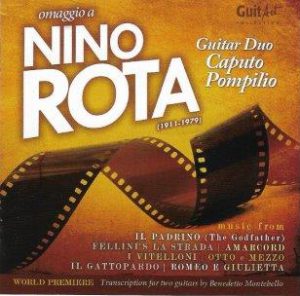
ROTA, AN INGENUOUS-GENIUS Nino ROTA was born in a family of musicians, and in particular his mother, Ernesta Rinaldi, gives him the first piano lessons. The young Nino reveals precociously his gift and his talent, so that at the age of four he has already given life to his first compositions. In 1923 he joins the music conservatory Giuseppe Verdi in Milan, and he studies with Paolo Delachi and Giulio Bas. In 1922 he composes L’infanzia di S.Giovanni Battista, written almost at the age of eleven and performed during the same year in Milan and the following year in Turcoing, in France; on the occasion of the French performance at request the public wants him to direct the repeat performance of the finale. In 1926 Nino Rota writes Il Principe Porcaro, a work for teenagers based on a fairy-tale by Hans Christian Andersen. Three quarters of an hour of a music which, considering the young age of the composer is judged from critics already mature, without wanderings from the points, intense and at the same time ironical. Afterwards Nino Rota studies privately with Alfredo Casella in Rome, gaining a diploma in musical composition at the conservatory Santa Cecilia in 1930. In 1930 he goes to U.S.A., and he stays there for two years, for some specialization courses and winning a scholarship in Philadelphia. After being returned in his native land, he takes an Arts degree at the University of Milan, with a degree thesis about Gioseffo Zarlino. In 1939 he is requested at the conservatory Niccolò Piccinini in Bari, where he’ll teach harmony and composition; he’ll become the rector of this institute in 1950. Between the years after the First World War and the post-war period, Rota starts his cooperation with the world of the cinema. After having realized his first musical accompaniment for the Renato Castellano’s film Zazà in 1944, Rota meets Federico Fellini, busy with the production of Lo Sceicco Bianco. In that situation a lasting joint work was born, which will make this artists work together for lots of years, realising numberless masterpieces. In 1972 Rota composes the sound track for the film Il Padrino, and two years later, for Il Padrino-Parte II. The composer dies shortly afterwards the end of the entries of his last sound track for a Fellini’s film, Prove d’Orchestra. Nino Rota is surely famous almost thank to his compositions for the world of the cinema, but he has been a prolific composer in all kinds of music, realising works for the theatre, the ballet, the symphonic kind and the lyrical one, too, receiving the international critics approval. In a period, which has been tied to radical renewing of the music language, and ruled by the Darmstadt’s avant-gardes and by the twentieth century new trends, Rota has been able to impose himself with a style of his own as simple and ingenuous, as ironical and sagacious. He joins the thematic purity to a sure harmonic elaboration coming directly from the veristic school of the Italian opera. The great instrumental competence, the deep knowledge of composition technique and the ingenious melodic intuition makes of Nino Rota a fundamental personage in the musical panorama of Italy and of the world in the last century. THE PIECES OF THIS CD At the beginning of ’70, Francis Ford Coppola contacts Rota to make him compose the soundtrack for the film IL Padrino. In particular Coppola wants to give the film a bit of extreme “Italianity”, which has to show up from the soundtrack too. That’s why Coppola is looking for an Italian composer like Rota, already known and appreciated by the international critics thanks to Fellini, who wins the Oscar for the film La strada in 1954.The proofs of the partnership between Rota and Coppola are curious and connected to a tape where the director and composer’s voices are recorded while, the former playing the piano and the latter singing, they pick out the accompaniments and the themes in a vague English (from Rota’s side obviously). The result is clamorous, on every side: the film and the sound track are very successful, but Rota doesn’t win the Oscar because some themes of the sound track are new elaborations of previous works for the cinema (see the film Fortunella in 1958) and for the so called serious music (composition for the piano).Anyway, Rota will win the Oscar two years later with Il Padrino parte II. The new elaboration and reutilization of his own work (no one else !) is a strange and typical thing, because it reveals the practicality of the composer’s way of working that has always been characteristic of all the great composer of the music history: see Rossini! An emblematic work, for example, is La strada. The ideas here in this score will be the slow-match for a lot of scores of other films (Il bidone, Rocco e i suoi fratelli), but also for symphonic score and for a ballet, too, become famous for Carla Fracci’s brilliant interpretation. Rota contributed with his music to the success of a lot of films. Zeffirelli wanted Rota for the Romeo e Giulietta .In this score Rota’s genius has been able, thanks to the immediacy of the themes, to suggest and to portray wonderfully all the climax of the film, from the heartache to the chronologic setting, from the desperation for the protagonists’ death to the sensuality of adolescence. Another masterpiece is the score of Visconti’s film Il gattopardo where the freshness of the theme blends once again with harmonious knowledge. Particularly the excerpt of the very famous dancing scene where the motif of the popular dances seems to spout from the composer’s pen together with the two waltzes that mark a period of decadence together with renovation. Last but not the least Fellini. The director and Rota are considered an almost indissoluble unicum, one complement to the other. As mentioned before, La strada represented the revelation of two genius, not just because it won the Oscar, but because, most of all for Rota, this work has been the beginning of lots of other compositions. The score of La strada is a reference mark in Rota’s artistic production because of the expert way of elaboration, which, as said above, will be adapted for other requirements (symphonic and for the ballet). The last piece of this CD is a mix of the most famous themes which belong to the Fellini’s films: Amarcord, I vItelloni e Otto e mezzo. We must emphasize how Rota’s versatility takes him to master easily not only the “classical” writing but also the most various styles from the “light” music to jazz. You can find several examples in his productions connected to the cinema and not only. In Amarcord you can find all his love of South American and popular rhythms, while in I vitelloni you perceive the blues atmosphere that matches magnificently with the Adriatic setting of Fellini’s film that will result in the jazz style of the themes of La dolce vita. It is worth mentioning Rota’s ability in “circensian” themes. This kind of music connected to this setting is in everyone’s heart and, the final marcetta in Otto e mezzo, represents the typical and worthy representation. .